 |
|
Hamden Weather |

Whitneyville Before Elvis
From the childhood memories of Raymond K. Johnson
Shell Game
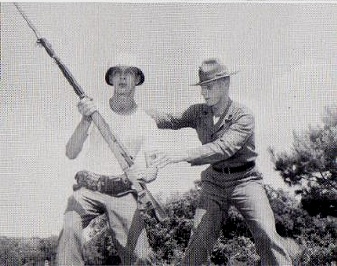
Pvt. R. K. Johnson (me) and Sgt. R. J. Larsen. Courtesy photo
By Raymond K. Johnson
Before I return to my boot camp adventures I am going to "break the fourth wall" in order to explain something brought to my attention by my wife, Kay -- my conscience. After reading my last column, “Head Call -- Denied,” Kay looked at me and gave me “that little chuckle.” You men out there know what that is. The smile that accompanies the chuckle means one thing -- I am about to get a lesson about something.
Kay went on to explain that not all my readers were in the military and my characterization of Sgt. Ramirez might leave the impression that he was being mean to the men in the platoon.
“But, honey, he was …” was as far as I got.
“Well that’s the impression I got while reading the article and what I think he was doing was teaching you recruits discipline, obeying orders without questioning them. Isn’t that what you Marines are always talking about?” was her reply.
Of course, she was right. That’s what boot camp is for, to train 72 recruits to charge up a hill and take out a machinegun nest. Recruits who only two weeks ago had to be told three times by their mothers to take out the garbage. And our drill instructors had but 12 weeks to get this discipline, this blind obedience and unswerving allegiance instilled in us.
And with that said we can start the beatification process for Sgt. Ramirez.
The first time I can remember it being a specific day of the week was on Sunday, the March 29. Our senior drill instructor, Staff Sgt. Larsen, called the platoon to attention after morning chow and asked if anyone wanted to attend Easter services. Staff Sgt. Larsen had the kind of face you saw on recruiting posters: thin with a jaw that looked as if it was made of iron. His voice was raspy and deep and he could bore holes through you with his stare. But he was a fair man, and although he could really be tough on you, he only was when you deserved it.
A few of us left the platoon formation and were taken to the Third Battalion chapel for Easter services. The rest of the men marched up the road to the drill field for some extra close-order drill. First thing I did right at Parris Island.
Staff Sgt. Larsen left most of the drill and teaching duties to the junior drill instructors he observed most of the time and within a week he knew every recruit by name. One of the things he did daily was to hold mail call for the platoon. We received our mail each evening after chow. Sgt. Larsen would call us out from our Quonset huts and we would fall in at attention in front of the drill instructors’ hut. Sgt. Larsen would call out the names on the envelopes and the recruit would answer “sir,” then run around the formation, past the drill instructor and grab the letter as he passed by -- much like a running-back taking a handoff from the quarterback in a football game.
A few days after Easter we fell out for mail call and waited for our name to be called. One by one Sgt. Larsen called the names out and handed off the mail as the recruit raced by.
“Johnson!” (There were two Johnsons in the platoon -- K. E. Johnson and R. K. Johnson.) Karl was one of the smartest men in the platoon and was a very quiet person. We had made an agreement that whenever the name “Johnson” was called, I would be the one to respond, “Sir, which one sir?”
“Sir, which one sir?” I called out.
“R. K.,” he replied
I raced around the formation and reached out for the letter and saw a small package in Sgt. Larsen’s outstretched hand. Sgt. Larsen was boring holes through me with his stare. I stopped and came to the position of quivering attention. Sgt. Larsen asked me if I had told my parents not to send packages. I told him I had. He turned the address on the package towards me and asked me to read the return address. It was from my girlfriend, Rosemary.
I looked up at Sgt. Larsen and told him who it was from. Behind Sgt. Larsen I could see Sgt. Ramirez. Sgt. Ramirez was smiling.
“Open the package, Pvt. R. K. Johnson,” said Sgt. Larsen.
I untied the string on the package and put it in my pocket. I removed the brown paper wrapping and put it in my pocket. I opened the little box and removed a small piece of cotton and put it in my pocket. Inside the little box were two Easter eggs. One was pink and one was blue. The pink one had the words “I love you” on it; the blue one had lots of “X’s.”
I looked up at Sgt. Larsen. Behind Sgt. Larsen I could see Sgt. Ramirez. Sgt. Ramirez was still smiling.
“Go ahead and eat your eggs,” said Sgt. Larsen.
I peeled one of the eggs and started on the second one but was interrupted by Sgt. Ramirez, who yelled, “He said eat them, not peel them.”
I shoved the two eggs into my mouth and started to chew -- shells and all (I think this is the “obeying orders” part Kay had talked about). There was no way I was going to be able to swallow the stuff I had in my mouth.
Sgt. Ramirez then ordered me to whistle the “Marine’s Hymn.” I looked at him and that big grin on his face. I came to attention, took in a deep breath through my nose, looked directly at Staff Sgt. Larsen and started to whistle.
Pieces of egg, eggshell and spit shot from my mouth and landed on Sgt. Larsen’s shirt, campaign cover and face. Sgt. Larsen was turning a deep shade of purple and Sgt. Ramirez was doubled over laughing. I turned and ran up the road towards the drill field with Sgt. Larsen about three steps behind me. I stopped when he yelled and ordered me to halt, and then told me to go back to the platoon and rejoin the rest of the men.
The mail call proceeded and when it was over we all went back to our huts to read our mail and write letters home. The jury was divided in the hut. Half of my new friends bet I was going to be killed; the other half thought I was an idiot. I agreed with both schools of thought.
Later we did hear some conversation from the drill instructors hut between Sgts. Larsen and Ramirez, with Ramirez doing most of the listening. I went to sleep that night knowing that Sgt. Ramirez and Pvt. R. K. Johnson had unfinished business.
Next: The rifle range
Raymond K. Johnson grew up Hamden and graduated Hamden High School in 1957. Two years later he enlisted in the Marine Corps, from which he retired in 1979. He now lives in Oceanside, Calif., with his wife, Kay. He is penning his memories of growing up in Whitneyville in this column. Johnson can be reached at rkjohnson1@cox.net.
August 3, 2008
Head Call -- Denied!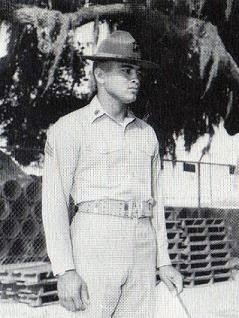
Sgt. Ramirez at boot camp. Courtesy photo
By Raymond K. Johnson
If it is possible for a person to be in a state of shock for 12 weeks, then that is the condition I was in from March until June of 1959. Not just me, but the other 71 “warm bodies” of Platoon 314, 3rd Recruit Training Battalion, Marine Corps Recruit Depot, Parris Island, S.C.
Trying to write a story about the military is not easy. The five services have their own vocabulary, strange words that mean nothing to the average civilian. A story about Marine Corps boot camp is especially difficult, because in addition to the strange words there is profanity. I would put the percentage of the latter at about 90 percent.
I believe most profanity in the world today originated at Parris Island. Add to that the fact that all instructions were yelled at us from somewhere in the 140 decibel range (equal to the noise produced by firearms, air raid sirens and jet engines), it is no wonder that my fellow recruits and I acted like zombies most of the time.
On the first day we were taken to the Clothing Issue building where we were issued our new clothing and got our first haircuts. I watched as my Elvis-length hair fell to the floor. That was my first mistake and my second meeting with Sgt. Ramirez, who seemed to take a special interest in my foul-ups. My error was in looking down at my hair as it fell to the floor. We had been given orders to “sit at attention” while in the barber’s chair. This meant “eyeballs straight ahead, maggot.” Sgt. Ramirez really liked that word (maggot), especially when yelling at me.
The first week we spent most of our time marching: marching to sick bay for shots, marching to chow, marching from chow, marching to the head, marching to the showers, marching to nowhere in particular. Third Battalion was considered a “Country Cousin” by the other two battalions. First and Second Battalions had big two-story wooden barracks and a huge drill field where all the marching (they called it “close order drill”) was conducted.
Third Battalion recruits were housed in Quonset Huts -- 16-foot-by-36-foot corrugated steel buildings -- and conducted their close order drill on a very small drill field situated on the side of a hill. It seemed we were always marching uphill. Our four drill instructors took turns, marching us for three or four hours in the morning, and again in the afternoon after a 30-minute break for chow. They would switch about every hour and the new D.I. would always have on a nice starched and pressed uniform. Meanwhile, we were all soaking wet and nearly exhausted after the first couple of hours. This went on for almost a month.
Staff Sgt. Hamby was one of our junior drill instructors. He was hated by all 72 men in the platoon. When he drilled us we never got breaks; his cadence was bad, which meant we did not march well, which meant we got yelled at by the person responsible for our screw-ups.
One morning we had been marching for about two hours steady without a break. Sgt Hamby was in a particularly foul mood and had refused requests for a head call from several of the recruits. We had gone directly to the drill field from the mess hall and it had reached the point where something had to give. About that time Sgt. Ramirez took over the drill session and gave us the order to march. A voice from within the ranks said, “We need to make a head call.”
Pvt. Hoffman had just committed the cardinal sin of “talking in ranks.”
Sgt. Ramirez halted the platoon and gave the order: “Right face.”
We were now lined up 24 men abreast and three rows deep on the side of a hill. Sgt. Ramirez stood in front of us, slightly below on the incline.
“Who said that?” he yelled.
“Pvt. Hoffman requests permission to make a head call.” said Pvt. Hoffman.
“What’s the first word out of your mouth, maggot?” yelled Sgt. Ramirez.
“SIR, Pvt. Hoffman requests permission to make a head call!” said Pvt. Hoffman.
“The platoon made a head call after chow!” yelled Sgt. Ramirez.
“No we didn’t,” said Pvt. Hoffman, his voice beginning to break.
“What’s the first word out of your mouth, maggot?” yelled Sgt. Ramirez.
“SIR, NO WE DIDN’T!” yelled Pvt. Hoffman. The dam was about to burst.
Sgt. Ramirez stood there for a moment deciding if he should kill Pvt. Hoffman for out-yelling him.
We all watched as Sgt. Ramirez slowly lowered his head and looked down at his feet. A little trickle of water came from where Pvt. Hoffman was standing at attention. The little river was running down the hill directly between Sgt. Ramirez’s spit-shined boots. The river just kept going and going for what seemed like an hour. Sgt. Ramirez never moved an inch, never moved his eyes from the little river Pvt. Hoffman had created. He stood there and waited, and waited. The river subsided.
Maintaining his gaze on the damp asphalt Sgt. Ramirez asked, “Do you still want to make a head call Pvt. Hoffman?”
“Sir, no sir” was the reply.
“Right face, forward march!” yelled Sgt. Ramirez.
We started marching and finished the drill period without further interruptions.
It was then I realized that Sgt. Ramirez actually had a sense of humor.
Next: The Easter Eggs
Raymond K. Johnson grew up Hamden and graduated Hamden High School in 1957. Two years later he enlisted in the Marine Corps, from which he retired in 1979. He now lives in Oceanside, Calif., with his wife, Kay. He is penning his memories of growing up in Whitneyville in this column. Johnson can be reached at rkjohnson1@cox.net.
By Raymond K. Johnson
My first big trip away from home took place in June of 1957.
On Wednesday evening, June 12, 1957, my classmates participated in the “Class of ’57” graduation exercises on the athletic field at the high school. I did not attend.
Due to a clerical error, I fell 2.5 points short of having the required credits needed for graduation. I placed the blame squarely on the shoulders of the principal’s office; they blamed it on my pathetic grades over the past four years. The result would be that in the fall I would take one class to make up the shortfall and then receive my diploma. This setback meant little to me, but was a really big deal to my parents. The summer was not starting out as planned.
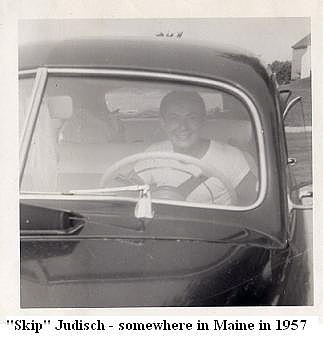
Skip Judisch, Jimmy Gillan and I were going to spend part of the summer taking a trip to Maine to visit some of Skip’s relatives. Skip had an old Pontiac that would be our transportation and home for the two weeks we planned to spend on the road.
The trip was delayed a week while I painted the house. Mom wanted the house painted; a job Dad had avoided for quite some time. Dad was not a handyman. His favorite tools were a putter and a cold Pilsner beer glass. I volunteered to paint the house if I could go to Maine. Dad agreed and even offered to pay me $20 for the job.
I finished painting in a week, got my money, and Skip, Jimmy, and I were on our way. We had a grand total of $60 between us. For the next two weeks we traveled through Maine and New Hampshire, and crossed the border at Levis and spent a day in Quebec City.
We camped out in hayfields and barns, bucked hay for food, and one night we slept in a cemetery, draping a large poncho over tombstones to form a makeshift sleeping area. Skip kept the car running, even disassembled the carburetor at one point, and for two weeks we had the best summer vacation ever. Our money ran out just miles from home, at the toll booth in Wallingford. We were allowed to continue without paying the 15 cent toll.
Jimmy joined the Air Force shortly after our trip. I went back to work at W.T. Grant, and Skip went on to get a degree at UConn and eventually joined the Navy. Skip was one of my best friends in high school. I don’t think I ever met a person with a more positive attitude. He didn’t think there was anything he couldn’t do, and in most cases he was right. He always had a big smile on his face and couldn’t wait for the next big adventure. My good friend, Skip, was injured in an accident on an aircraft carrier and died in 1979. I miss him.
My second big trip away from home took place in March of 1959.
Kenny DeMaio and I received our draft notices in February. I didn’t want to join the Army so I went downtown to the Marine recruiter’s office and looked into joining the Marines. I actually intended to join the Air Force but the Air Force recruiter was across the street getting coffee and the Marine recruiter invited me into his office for a few minutes; “just to talk” was what he said. A couple of hours later I was filling out enlistment paperwork.
My Dad was not happy with my decision.
“They’ll kill you down there,” was his first response when I told him I had joined the Marine Corps. He was referring to the Ribbon Creek incident at Parris Island, which occurred in 1956 when a Marine drill instructor marched his platoon into a tidal creek that resulted in the drowning deaths of six recruits. Mom didn’t say much about it at all, which meant she was very concerned. Mom was like that; the less she said about something the more concerned she was. For the next couple of weeks I ate peanut butter and banana sandwiches (one of Elvis’ favorites) by the dozen. The recruiter told me I might not pass the physical in Hartford because of my weight; I only weighed 102 pounds.
On March 2, 1959, my Dad drove me to the train station in New Haven. Mom stayed behind, saying her goodbyes at the curb. Dad didn’t say two words all the way to the station, and as I recall, neither did I. We went to the ticket window and Dad asked which track the train to Hartford would be coming in on. Then he went on to tell the man at the counter all about my joining the Marines. It was then I realized he was proud of me.
We went out to the track and waited for the train. There was a big baggage cart there full of boxes and crates. We looked at all the shipping tags and Dad would point at one and say, “I’ve been there” and “That sure has come a long way.”
About 15 minutes passed and the train rolled into the station. Dad looked at me and said, “Do as you’re told and you’ll make it.” With that said, he shook my hand and said goodbye. I saw his lip tremble as he turned and walked away.
An hour or so later, I was in the recruiting office in Hartford along with about 50 other kids my age getting physicals and sworn in. That evening we all boarded another train and were on our way to boot camp. Just before dark the train pulled into the New Haven train station and I looked up and down the tracks to see if Dad was still there. It was then it finally dawned on me that it would be a long time before I saw Whitneyville again.
The train ride took almost two days. We had sleeper trains but I don’t remember any of us actually sleeping. The other boys and I would be part of a Connecticut platoon at Parris Island. We had lots to talk about and before we knew it we arrived at a little South Carolina town called Yemassee. The world as I knew it ended right there. A Marine drill instructor began to yell at us -- most of the language can’t be printed here.
We got off the train, got in line and stood at attention. Sgt. Ramirez told us we would be staying overnight in the barracks in Yemassee and would be going to Parris Island in the morning. We spent the night in bunk beds sleeping “at attention.” Sgt. Ramirez said if he heard one sound … He didn’t hear any sounds.
The next morning we were taken to recruit receiving where we stripped down, took showers, were given our new uniforms and then taken to the mailroom. It was there that I rolled up my Levi’s, Levi jacket, engineer boots, black leather belt and wrapped them in brown paper. I wrote: “Mr. Graham Johnson, 42 Francis Avenue, Hamden, Connecticut” on the package and tossed it into a large bin along with all the other packages. All this was happening as Sgt. Ramirez and three other drill instructors were screaming orders at us. Total confusion and shock seemed to be their objective. It worked.
But I am from Whitneyville, Conn. Good tough New England stock. You can take the boy out of Whitneyville, but you can’t take Whitneyville out of the boy.
Next adventure: 12 weeks of boot camp.
Raymond K. Johnson grew up Hamden and graduated Hamden High School in 1957. Two years later he enlisted in the Marine Corps, from which he retired in 1979. He now lives in Oceanside, Calif., with his wife, Kay. He is penning his memories of growing up in Whitneyville in this column. Johnson can be reached at rkjohnson1@cox.net.










Site designed by Joanne Kittredge

Tip Us Off
Send
news tips